
CLS INFRA Literary Studies in the Digital Age
| Duration: | 2021-2025 |
| Subsidy provider: | European Union’s Horizon 2020 research and innovation programme |
| Subsidy size: | 5 million euro |
A better foundation for Computational Literary Studies
Digital technologies support traditional literary research and open up new possibilities. CLS INFRA was set up to help scholars get started, so that even self-proclaimed Luddites and those who describe themselves as ‘digitally illiterate’ in literary studies don’t have to shy away from IT or AI.

Medusa on a PC. (C) Huygens Institute, generated by ChatGTP.
The world is becoming ever more digital, and literature is no exception. Increasing numbers of literary works are now available online, while large-scale information and research are also more easily accessible. Across Europe, huge amounts of literary data have already been digitised.
On top of that, digital tools and specialised software are increasingly being used to study literature. This field, known as computational literary studies (CLS), uses digital methods to draw fresh insights from old texts and their contexts.
What counts as literary data?
Literary data includes both the texts themselves (novels, poems, plays) and information about them (authors, publication details, annotations). It also covers works that once existed only on paper but have since been digitised.
The problem is that this data is scattered. Some is kept in digital libraries, some in archives, often in different formats and layouts. This makes it hard to draw on multiple sources at once, or to integrate them in a single research project.
How CLS INFRA strengthened foundations
Funded by the EU and involving 14 partners from across Europe, CLS INFRA set out to build a better infrastructure for literary data. It pulled material from different libraries and archives, converted material to common standards and set up shared systems. This makes it easier for researchers to find, combine and use literary data.
CLS INFRA as a network of people
CLS INFRA wasn’t just about data. It was first and foremost a network of people. It brought researchers together for meetings, training sessions, knowledge-sharing, collaborations and one-to-one support. This gave opportunities to those wary of ‘numbers and statistics’, or working at smaller institutes with limited budgets, to get to grips with the emerging field of computational literary studies.
For example, CLS INFRA offered TNA fellowships that allowed researchers to learn from each other and develop their skills. The results were shared with the wider community, with strong support from the Huygens Institute, through workshops, training and other activities.
A boost for computational literary studies
As part of the project, new tools and guides were developed to show literary scholars how digital tools and methods can be used. Many of these resources are still available on the now-archived CLS INFRA website, while presentations and videos can be found on the project’s YouTube channel.
The role of the Huygens Institute
The Huygens Institute is a leading centre for computational literary studies in the Netherlands. It was keen to work with CLS INFRA partners to help strengthen international collaboration in the field.
Explore the CLS INFRA website to see how digital technology can be used in literary research.
Partners
- Institute of Polish Language at the Polish Academy of Sciences, Poland
- University of Potsdam, Germany
- Austrian Academy of Sciences, Austria
- National University of Distance Education, Spain
- École Normale Supérieure de Lyon, France
- Humboldt University of Berlin, Germany
- Charles University, Czech Republic
- Digital Research Infrastructure for the Arts and Humanities, France
- Ghent Centre for Digital Humanities, Ghent University, Belgium
- Belgrade Centre for Digital Humanities, Serbia
- Huygens Institute for Dutch History and Culture (KNAW), Netherlands
- Trier Centre for Digital Humanities, Trier University, Germany
- Moore Institute, National University of Ireland Galway, Ireland
The city and its novels: an example of CLS research
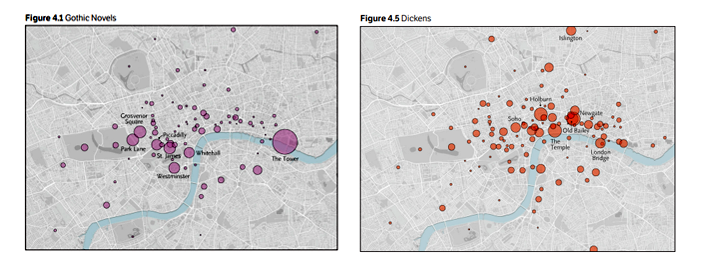
In the nineteenth century, English novelists used London and its surroundings as an emotional backdrop. Over time, the setting shifted: from the grimy world of crime and punishment, as seen in Gothic novels, to the more everyday spaces of modern professions, as seen, for example, in the novels of Charles Dickens. (Source: The Emotions of London, Stanford University, 2016).