
eDITem
| Duration: | 2023-current |
| Subsidy provider: | Stichting PICA (Verbonden Digitaal Erfgoed) |
A modular publication tool for digital editions
For many years, the Huygens Institute has been publishing leading digital editions of cultural-historical and historical sources. Previously, each edition often had its own digital environment, which became outdated or incompatible with new digital developments. With the eDITem project, we are developing a standardised, reusable and open-source publication tool. Thanks to flexible templates, editions can be published faster, more consistently and more sustainably, allowing historical sources to be made available online more efficiently.
Image: Huygens Institute, generated by AI.</em
Why eDITem?
Digital editions can vary greatly in content and form, but often consist of similar components: images of the primary sources, transcriptions and additions such as translations, notes, introductions, biographies, bibliographies and other contextual explanations. These elements recur in almost all editions.
By placing these components in generic templates, we can standardise them. Only truly unique features of an edition still require customisation. This saves time and resources. Moreover, because of the shared format, editions can be linked together and consulted and searched in a single interface. The use of Linked Open Data further increases searchability and findability.
What is eDITem developing?
eDITem is a modular publication architecture for digital editions. The tool consists of templates that can be applied to a wide range of sources and edition types, while leaving sufficient room for content-related and scientific choices. There are templates for letter editions, modern manuscripts, published articles and supporting components such as introductions, biographies and bibliographies.
Interdisciplinary collaboration
The eDITem project team is interdisciplinary and consists of scholars from the Digital Editions and DHLab research groups, as well as research software engineers from Team Text of the Digital Infrastructure department within the KNAW Humanities Cluster. This collaboration brings together editorial knowledge, research methods and information technology.
The digital architecture of eDITem is being developed based on the expertise of the Innovating Digital Editions research group, which has in-depth knowledge of historical texts and sources. The technical specialists of Team Text ensure the connection to a modern, sustainable publication infrastructure for a wide range of document types and file formats.
Collaboration partners
We collaborate with, among others, Van Gogh Museum Amsterdam, RKD (Netherlands Institute for Art History) and Gelders Archief.
Open source software
The eDITem tool is initially being developed for edition projects of the Huygens Institute. The software is open source and therefore also available to other institutions and researchers working on digital editions of historical sources.
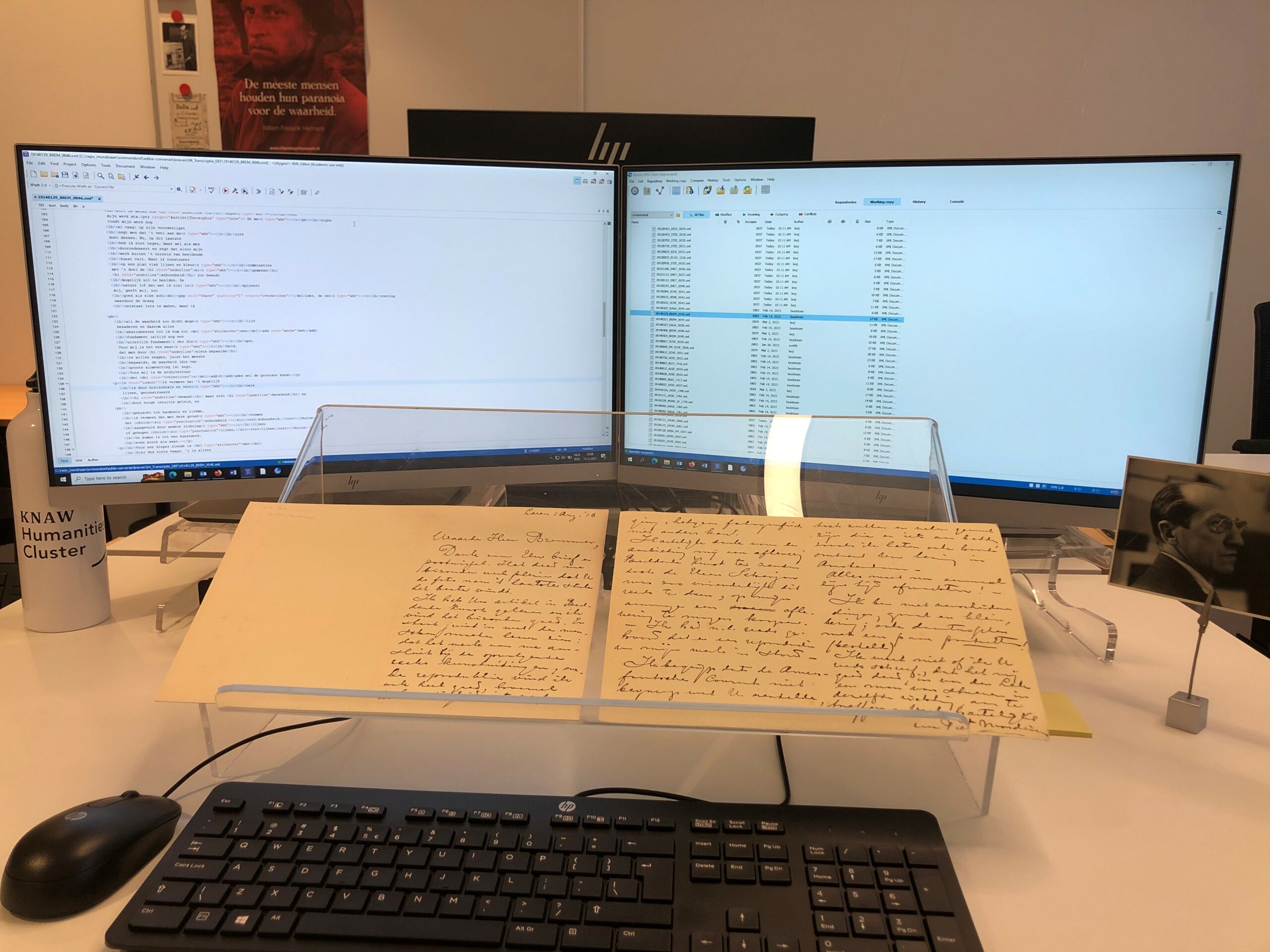
The eDITem project develops sustainable software for digital editions.
Project phases and letter editions
In the first phase of the project, we developed and tested eDITem templates within the project The Mondrian Papers. This resulted in a first version of the publication architecture, with templates for letters, modern manuscripts, published articles and supporting components such as introductions, biographies and bibliographies.
In the second phase, we are applying the templates to both new and existing letter editions and developing them further. This is being done within the editions Israëls Letters, Van Gogh Letters and The Mondrian Papers, among others. This phase is supported by a grant from the PICA Foundation (Connected Digital Heritage), under the project title Artists’ Letters.
In collaboration with the Van Gogh Museum, a digital edition of the letters from Isaac Israëls to Jo van Gogh-Bonger, the wife of art dealer Theo van Gogh and sister-in-law of Vincent van Gogh, has been realised. In addition, we are working on a revised edition of the Van Gogh Letters and an expansion of The Mondrian Papers.
From early 2026, we will be preparing a digital edition of letters to Duchess Mechteld van Gelre (c. 1325–1384), which are preserved in the Gelders Archief. We will also be using eDITem for the diplomatic correspondence of Christofforo Suriano and Alvise Contarini.
Further explorations
In addition to letter editions, eDITem is investigating the possibilities for other types of sources and editions. The project is exploring whether existing digital editions within the Huygens Resources can be renewed and better linked to each other using eDITem.