
Letters from Alvise Contarini (1624–1626)
| Duration: | 2025–2027 |
| Subsidy provider: | Privately funded |

Diplomatic observations of the third Venetian envoy to the Dutch Republic
The Huygens Institute is compiling a digital edition of the letters of Alvise Contarini (1624–1626), the third Venetian envoy to the Dutch Republic. The project is a direct follow-up to the previously published edition of the letters of Christofforo Suriano (1616–1623), the first Venetian envoy. Together, the correspondences form a unique, continuous serial source for studying politics, diplomacy, trade and culture in the contacts between the Serenissima Repubblica di Venezia and the young Dutch Republic in the early 17th century.
Image: portrait of Alvise Contarini after Anselm van Hulle (detail), anonymous. Collection Nationalmuseum.
The Huygens Institute project team, led by Nina Lamal, is collaborating with a team of Italian palaeographers to transcribe all the letters in full, make them searchable, annotated and provided with English summaries. Historically relevant appendices will be included in full and made digitally accessible.
From Suriano to Contarini: a continuous serial source
The Dutch Republic was young, Protestant and relatively decentralised. The oligarchic, Catholic Republic of Venice was the exact opposite. This difference made the new Dutch state both interesting and potentially problematic from a Venetian point of view. There was much to learn, but also much to argue about with the Calvinist ‘rebels’ in the Low Countries.
Who was Alvise Contarini? A top Venetian diplomat
With the arrival of the second Venetian envoy, Marcantonio Morosini, in the summer of 1623, Suriano was able to return to Venice after more than seven years. Morosini’s appointment was temporary. In the same year, the Venetian Senate decided to send Alvise Contarini as an official ambassador to The Hague.
Unlike Suriano, Contarini was a Venetian nobleman. During his tenure in The Hague, he witnessed the Siege of Breda (1624–1625). Contarini observed the military and political situation closely and reported extensively on it to Venice. Not least because Venetian soldiers were fighting alongside the Republic.
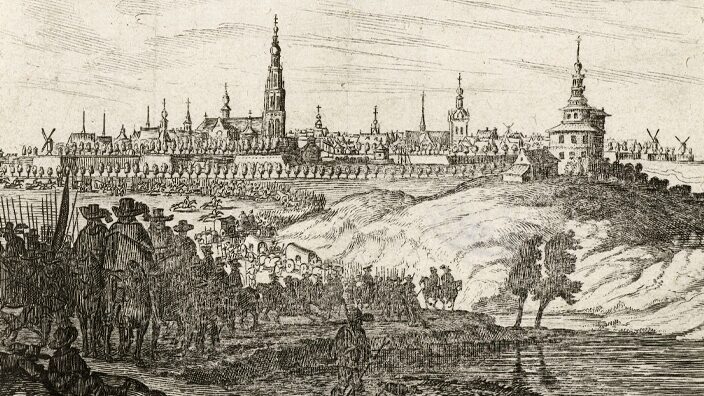
Siege of Breda, 1624-1625. Rijksmuseum Collection.
After his years in The Hague, Contarini became one of the most influential diplomats of his time. He represented Venice in England (1626), France (1629), at the papal curia (1632) and in Constantinople (1636–1641). He played one of his most important roles during the Congress of Münster (1641–1648), where his diplomatic skills as a mediator contributed to the Peace of Westphalia.
Lively observations of the Dutch Republic
Like Suriano, Contarini was trained to take verbatim notes of conversations and to observe political and social developments closely. Their correspondence provides an exceptionally detailed account of the daily functioning of the Dutch Republic: from the States General to international trade, religious tensions and diplomatic rituals.
Research and book for the general public
Project leader Nina Lamal is investigating how Suriano and Contarini portrayed the Dutch Republic in their correspondence. The results of this research will eventually be published in a book for the general public about the Venetian view of the fledgling Dutch Republic.
Italian perceptions of the Revolt in the Netherlands
Nina Lamal has previously contributed to the collection De Tachtigjarige Oorlog in Europese ogen. De Internationale Geschiedenis van een Nationaal Verhaal (Boom, 2025). In her essay, she describes how various Italian figures, including numerous soldiers stationed in the Low Countries, played a key role in gathering information about the Dutch Revolt and the establishment of the fledgling Dutch Republic.
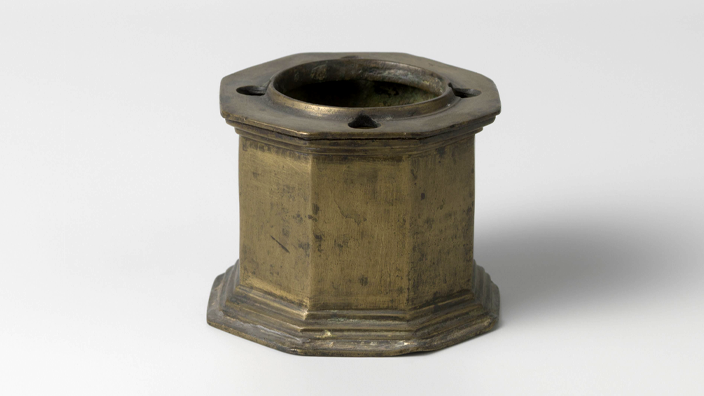
Brass inkwell with holes for pens. Rijksmuseum collection.
The Venetian cipher: a digital challenge
A major challenge within the project is the frequent use of cipher in Contarini’s letters. Venetian diplomats were among the most advanced users of secret writing in early modern diplomacy. Contarini worked with an extensive symbol system that combined letters, syllables and entire words.
The Huygens team is developing a digital edition in which users can see both the original cipher and the deciphered text. The letters will be made easily searchable, with transcription, deciphering and interpretation clearly presented side by side.
Digital edition: accessible and richly annotated
The digital edition of Contarini’s letters will include:
· Images of the original letters
· Searchable transcriptions
· Deciphered secret passages
· Annotations of persons, places and institutions
· English summaries
· Link to the Suriano edition for serial analysis
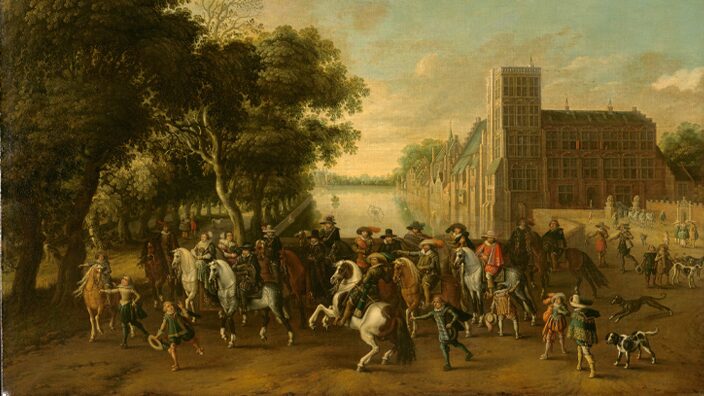
Prince Maurits in company at the Buitenhof in The Hague, Pauwels van Hillegaert, 1621-1625. Rijksmuseum Collection.