
Letters from Christofforo Suriano (1616–1623)
| Duration: | 2020–2024 |
| Subsidy provider: | Privately funded |

Testimony and wonder of the first Venetian envoy to the Dutch Republic
In the early seventeenth century, few contrasts were sharper than that between the young Dutch Republic (strictly Protestant and founded by rebels against the Spanish king) and the Repubblica di Venezia (Catholic and dominated by a powerful political and economic elite). And yet, the two states entered into diplomatic relations. This was hardly a smooth process: it involved plenty of friction, negotiation, and mutual irritation. The digitised letters of Christofforo Suriano, the first Venetian envoy to the Dutch Republic, provide a rare and vivid glimpse into this uneasy but fascinating alliance.
The edition of Christofforo Suriano’s letters, consisting of 725 letters with over 7,000 pages, was digitised and enriched over a period of four years by the Huygens Institute, led by Nina Lamal and Helmer Helmers in collaboration with a team of Italian palaeographers.
Image: An oldscholar (detail), copy after Gottfried Kneller (1645–1672). Collection of the Rijksmuseum.
Una descrizione del progetto in italiano è riportata sotto il testo inglese.
‘They cook everything in butter’: the amazement (and horror) of a foreigner
As the first Venetian envoy to the Dutch Republic, Suriano found himself in a world that was entirely unfamiliar. During his six years as a diplomatic representative in The Hague (he was never formally granted the title of ambassador), he not only had to keep relations between the two republics on track, and at times get them moving in the first place, but also to find his own footing in a setting where the language, customs, and social codes were strange to him.

Still life with cheeses, almonds and pretzels, Clara Peeters, c. 1615. Mauritshuis, The Hague.
For example, he considered women in the Dutch Republic to be very liberal. He begged his Venetian employers to send a Catholic priest to The Hague as soon as possible, because where could he find salvation among all those Calvinists? And he complained about Dutch food: everything was cooked in butter, much to his dismay.
Unique historical source from the early 17th century
The majority of the letters concern diplomatic matters. Between 1616 and 1623, Suriano wrote weekly to the government of Venice, the Doge and the Senate. In more than 7,000 pages, he described in detail who he met and what he discussed with them. He did so meticulously and in great detail. He often recorded dialogues verbatim, word for word, for example with Maurice of Nassau, Prince of Orange. And then Maurice said this… and then I said that… and then Maurice said this…
Thanks to this accuracy, the letters provide a unique insight into political and diplomatic relations, as well as into the people and organisations that shaped the Netherlands at that time.
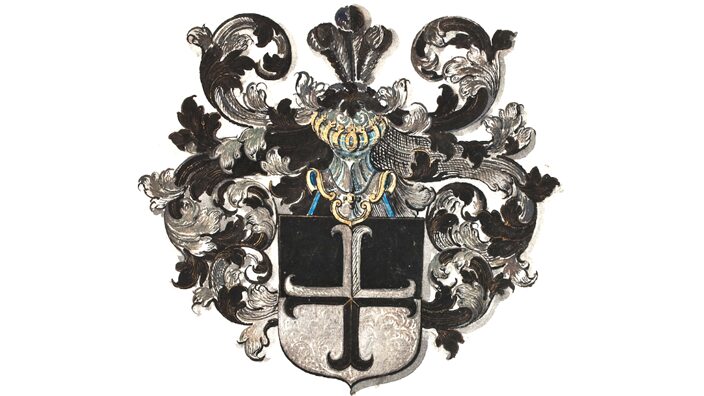
There is no portrait of Christofforo Suriano. However, his coat of arms has been preserved in Isaac Massa’s album amicorum (78 H 56) in the Royal Library in The Hague.
The Venetian cipher: secret language in code
The project team transcribed, annotated and digitally accessed the letters in the Archivio di Stato di Venezia archive.
Secrecy was essential in early modern diplomacy. Venetian diplomats and ambassadors were early adopters in this regard and used secret writing and code in their letters. Suriano also used a Venetian cipher to protect sensitive information in his letters. This code combined letters, syllables and words using a system of 295 symbols and was controlled by the Venetian Council of Ten.
Although Suriano did not always apply the code strictly, the project team was able to fully unlock the encrypted letters thanks to historical transcriptions and modern decoding tools.
Digital edition: search the letters online
Thanks to advanced digital infrastructure, text analysis and semantic enrichment, both historians and interested readers can easily navigate and analyse the digitised letters. The digital edition makes the letters accessible with:
· Images of the original letters
· Searchable transcriptions
· English summaries
· Annotations and biographies of people mentioned in the letters

De zielenvisserij (fishing for souls), Adriaen Pietersz van de Venne, 1614. Politics and religion are inextricably linked. On the left are Protestant leaders of the Dutch Republic (including Maurits), on the right are Catholic deans who rule the Southern Netherlands. Rijksmuseum collection.
La corrispondenza di Christofforo Suriano, delegato della Serenissima in Olanda (1616-1623)
Questo progetto editoriale presenta per la prima volta la corrispondenza completa (inedita) di Christofforo Suriano, il primo legato veneziano presso la Repubblica Olandese. Comprende tutte le lettere che Suriano inviò al Senato tra il 1616 e il 1623, per un totale di circa 7000 pagine. La corrispondenza di Suriano è di grande valore per la storia olandese ed europea del primo Seicento. Segna, inoltre, il punto di partenza delle relazioni diplomatiche ufficiali italo-olandesi.
All’inizio del Seicento, la Repubblica olandese era l’ultimo arrivato sulla scena internazionale. Dopo la conclusione della Tregua con la Spagna nel 1609, la diplomazia olandese ebbe un rapido sviluppo. La Repubblica olandese strinse alleanze strategiche per fronteggiare la Spagna una volta terminata la Tregua. In questo contesto, la Repubblica di Venezia ebbe un ruolo cruciale nella costruzione di un’ampia alleanza anti-spagnola. I Veneziani, d’altra parte, avevano un grande bisogno di sostegno straniero nelle loro operazioni militari. L’arrivo di Suriano nell’estate del 1616 fu quindi uno spartiacque per le due repubbliche.
Per i sette anni successivi, Suriano rimase all’Aia per rappresentare gli interessi della Serenissima presso la Repubblica olandese. Ogni settimana scriveva da una e tre lettere al Doge e al Senato. In esse rivela numerosi dettagli mancanti in altre fonti. Per esempio, registrava regolarmente alla lettera le conversazioni che aveva avuto con statisti e diplomatici all’Aia. Attraverso questo scambio epistolare, inoltre, gli studiosi acquisiranno nuove conoscenze sullo sviluppo dei rapporti tra queste due repubbliche e su numerose importanti questioni internazionali in vista della Guerra dei Trent’anni (1618-1648).
Tra i risultati del progetto vi sarà una moderna edizione digitale commentata con riassunti in inglese. Renderemo disponibili sia immagini in alta risoluzione delle lettere originali, sia un testo interamente ricercabile in open access. La ricercatrice per il progetto è la Dott.ssa Nina Lamal, il responsabile del progetto è il Dott. Helmer Helmers del NL-Lab del KNAW Humanities Cluster.
Le trascrizioni sono curate da Dott. Ruben Celani, Dott.sa Flavia Di Giampaolo, Dott.sa Federica D’Uonno, Dott.sa Vera Frantellizzi, Dott.sa Cristina Lezzi, Dott.sa Giorgia Proietti, Dott. Angelo Restaino, Dott. Filippo Sedda.