69 Volumes of Erasmus: Jan Bloemendal’s Labour of Love

Jan Bloemendal enjoyed teaching Classical Languages and Dutch for 14 years while working on his PhD in his spare time. In 2000, he switched from education to science. ‘It was quite a culture shock, but it worked out well.’ He went on to work at the Huygens Institute, where he is celebrating his 25th anniversary this year.
During his time at the institute, he has conducted research into early modern Latin theatre, including the TransLatin project. Since 2007, he has coordinated the Erasmi Opera Omnia project, one of the Institute’s longest-running initiatives. ‘It started in 1960, before I was even born!’ For decades, countless volunteers have worked on the scholarly edition of the 69-volume complete works of the humanist Erasmus (1466–1536). ‘It is both a tour de force and a labour of love.’
The Eternal Reviser
‘The Latin texts are critically edited, with explanations, background information, and notes on variations between old editions,’ says Bloemendal. ‘It’s a huge task because Erasmus was an “Eternal Reviser”. With each new edition, he revised his texts again.’
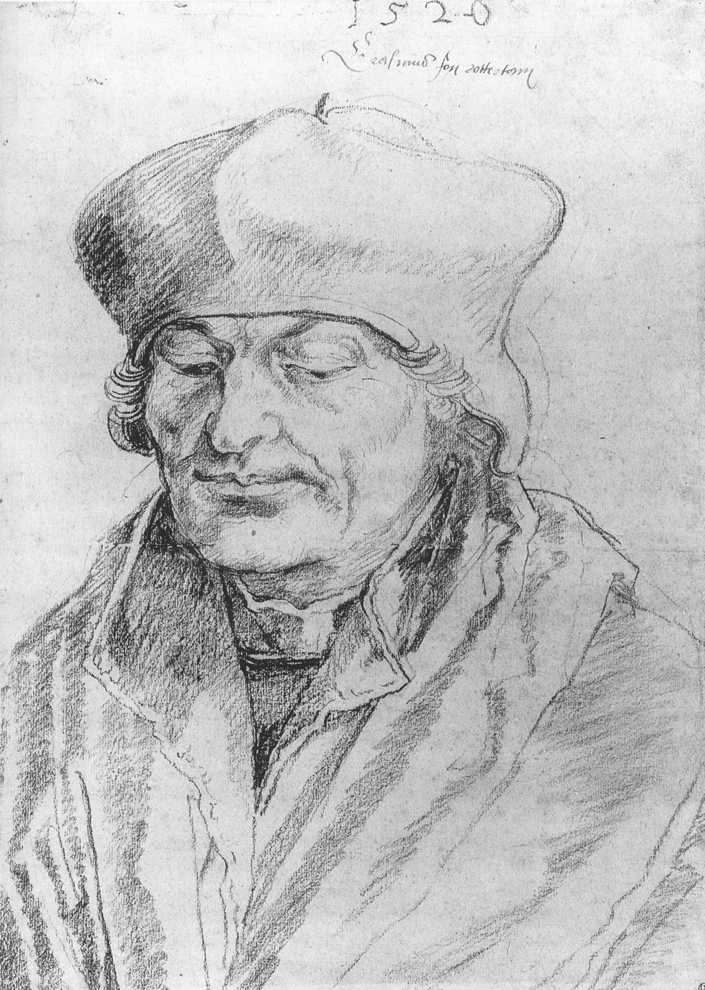
Portrait of Erasmus by Albrecht Dürer, c. 1520. Collection: Musée du Louvre.
The edition is being published in print, but parts will also be made available online. ‘The academic Erasmus community is quite conservative, “hence” a paper edition, but we hope to make a digital version in the future, ideally alongside an English translation of the Latin text. We have to move with the times.’
Not an Easy Person
Bloemendal has been studying Erasmus’ work for eighteen years. Who was this man? ‘An elusive figure,’ says Bloemendal. “He had many friends, but he could drop them like hot potatoes. He was a pacifist, yet sometimes hateful; thoughtful, yet touchy, what you might call “difficult” to get along with.’
European Values
‘Erasmus was a great scholar, but extremely vain. Nowadays, he’d probably appear on every talk show in Europe like a real star philosopher. He travelled widely in his own time, which shaped his influence on shared European values, as well as on a culture of respect and mutual trust. Sadly, we’re seeing that tolerance crumble today.’
Love for One’s Fellow Human
Bloemendal feels a strong affinity with Erasmus’s ideas. ‘Like me, he was both a scholar, a theologian and a man of faith. But unlike me, he believed that if you explain things clearly, people will benefit from it. A good education and upbringing should provide people with enough knowledge and wisdom to engage in dialogue and keep talking, even when they disagree.’
‘Love for one’s fellow human (I prefer that to “charity”) was central to Erasmus. To understand others, you need to know history and maintain what my mother-in-law used to call ‘healthy suspicion’. Ask yourself: is this really true, and why is someone saying it?’ Erasmus would call that critical thinking: the ability to avoid mistaking nonsense for truth and stubbornly clinging to it. He described that as a kind of folly in his most famous work, In Praise of Folly (1511).’
Nine volumes to go
So far, 60 volumes of Erasmus’s work have been published. Nine more to go. Of these, one is currently undergoing its first proofread, one is with the typesetter and one is under editorial review. Hopefully, the remaining six volumes will be completed before Jan Bloemendal retires in autumn 2028. A fitting moment to see this life’s work completed.