
NWO grant for interaction between literature and society

Combination of previously separate research methods should lead to breakthroughs and new insights
Elli Bleeker of DHLab and the Huygens Institute has received an NWO grant to develop and evaluate a new method for researching cultural and social influences on literary works. She will combine computational analyses with theoretical research and interactive visualisations.
Image: cover design for the series De Ideaal-Bibliotheek (The Ideal Library) by publishing company L.J. Veen, Johan Braakensiek, ca. 1914. Rijksmuseum collection.
A book is published, society condemns it, the writer revises the text. Or: a book is published, society changes, years later the text is adapted by the publisher. Literary works are not set in stone but are constantly being adapted, both during and after the author’s lifetime in a dynamic interplay between writers, readers and society.
How can we gain insight into these variations? How can we understand the revisions, adaptations, and omissions in literary works in the light of their cultural and historical context? These are the kinds of questions that literary scholars have been grappling with for centuries.
Mixed-methods approach to text study and computer analysis
Thanks to the NWO grant for Making Sense of Versions, researcher Elli Bleeker can develop and evaluate a new method to studying literary text variation from a micro and a macro perspective: within the text itself, linked to historical and cultural context, and at a structural level.
Bleeker will work closely together with an external research software engineer to develop interactive visualisations and built a browser-based research environment. This will enable researchers to investigate and visualise how literature and social values influence each other and interact to bring about change.
Close reading and computational stylistics
Traditional textual scholarship, such as close reading, accurately records which words or characters change, but has difficulty recognising larger patterns. Computational stylistics can reveal such patterns, but is rarely used to study the development of individual texts.
Traditionally, the two disciplines have remained separate, according to Elli Bleeker: ‘Within our project, we will investigate if and how their methods can be combined. This integration could fundamentally change our understanding of textual variations and the interplay between text and context. This could lead to a methodological breakthrough.’
Application to Dutch-language literature
The new approach is being tested on several Dutch-language literary works from the twentieth century that underwent significant revisions, for example under pressure from social resistance or due to personal choices made by the author. Examples include works such as Pijpelijntjes (1904) by Jacob Israël de Haan and Het dagboek van (de vrouw van) een beeldhouwer (1964, 1986) by Dirkje Kuik.
Tool for future researchers and projects
The project will be carried out in close collaboration with an international research network to ensure that the methodology and research environment meet specific scientific needs.
‘We don’t want to create an isolated tool,’ says Bleeker. ‘By working closely with the scientific community during development, we can ensure that we build something that is useful and responds to real challenges in this field of research.’
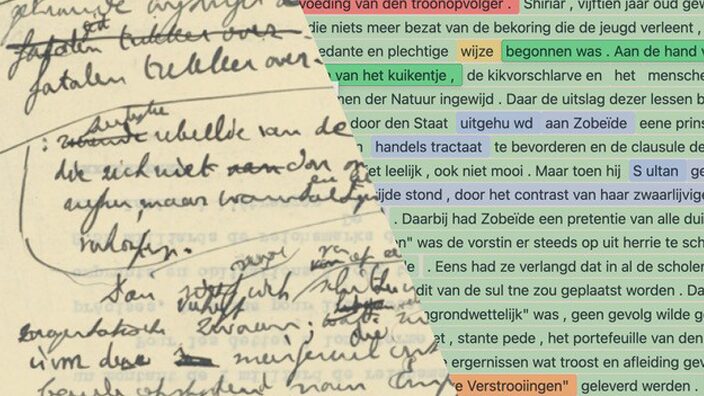
‘Bringing together two separate disciplines could fundamentally change our understanding of textual variations and the interplay between text and context.’
Upon completion, the methods, tools and research environment from this project will be made available as open-source software. This will enable future researchers to use them without requiring programming knowledge or special software installation.
Anne Frank Manuscripts
Elli Bleeker previously published the book Anne Frank, schrijfster (Dutch only) with Peter de Bruijn, a public version of the Anne Frank Manuscripts project. This research carefully examined the many revisions Anne Frank made to her work, enabling her literary development to be mapped out step by step.


