
New Maritime History of the Netherlands
Digital overview of Dutch maritime history
Nieuwe Maritieme Geschiedenis van Nederland (New Maritime History of the Netherlands) is a digital overview of Dutch maritime history. The publication brings together the latest research on the maritime history of the Netherlands from the twelfth century to 2020. It is the successor to the Maritime History of the Netherlands, which covers history up to around 1970.
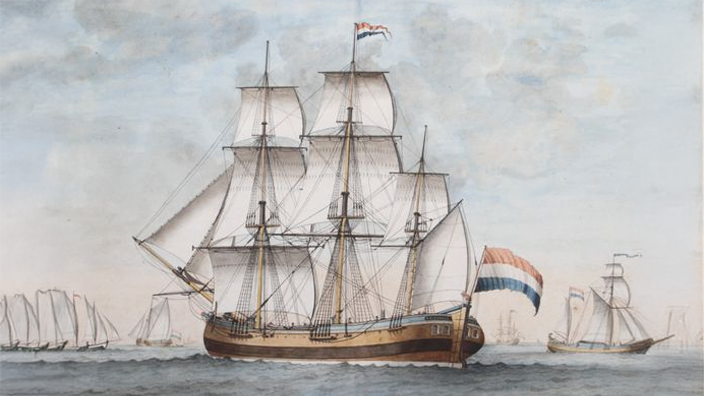
Image: ship portrait of the three-masted galleass D’Riegaase Post (detail). Gouache by Jan Mooy, 1806. Collection of the Fries Scheepvaart Museum, Sneek.
The Netherlands was shaped by water: sailing was a necessity for the landscape. From the twelfth century onwards, the importance of shipping increased significantly, partly due to the emergence of the Hanseatic League, a partnership between merchants and cities. What began as transport on inland waterways expanded, thanks to technological innovations, to the European coasts and eventually to the world’s oceans.
Maritime sectors through the centuries
This publication shows how the Dutch shipping sectors have developed and modernised since the late Middle Ages. It covers inland shipping, with a clear link to maritime shipping, and regional and international fishing, including whaling. A distinction is made between sea fishing and inland fishing.
In addition, merchant shipping and the flow of goods by water, both within and outside Europe, are discussed in detail. Other sectors are also discussed, such as shipbuilding, the navy, until 1780 in combination with privateering, and recent activities focused on the exploration and extraction of oil and gas at sea, further away from the coast.
Technology, networks and people
The focus is on the interaction between maritime activities and the development of ship types, navigation aids and trade networks. Maritime history is not only about ships and types of sailing, river and motor shipping, but also about the people and companies that organised shipping and the crews on board.
Maritime culture and heritage
Shipping has had a lasting influence on Dutch culture, from painting to words and expressions in the Dutch language. This cultural-historical dimension is also an integral part of the publication.
Structure of the publication
The New Maritime History of the Netherlands consists of four parts, each devoted to a clearly defined period. Each part opens with an introductory chapter in which the developments in the various shipping sectors are outlined in context and in broad terms, supported by visual material.
The individual sectors are then discussed by various authors who are experts in their field. Each part concludes with a maritime cultural-historical section covering topics that are characteristic of the period in question.
Go to the resource.