
A Show of Hands
| Duration: | 2025-2031 |
| Subsidy provider: | Art, Books and Collections Foundation |
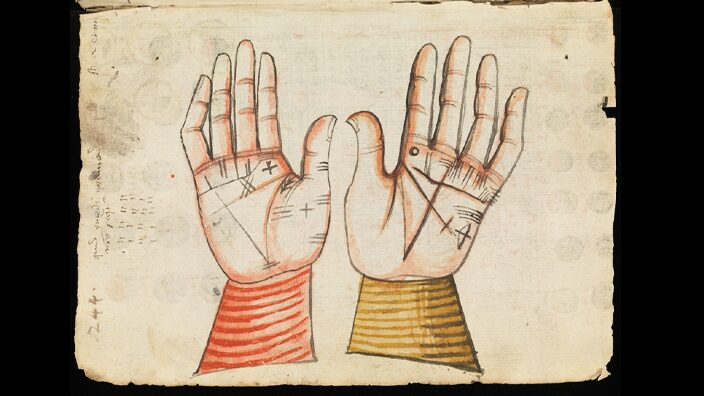
This page is from a manuscript (c. 1400–1450) on geomancy (divination through the earth), chiromancy (palmistry), iatromathematics (medical mathematics), astronomy, alchemy, and medicine. Source: Sankt Gallen, Stiftsbibliothek, Cod. Sang. 756, p. 244.
👉 The Role and Function of Hand Images in Medieval Manuscripts (900–1550)
This project investigates the role of hand images in medieval manuscripts (900–1550). The project demonstrates how these images were employed in medieval texts to aid learning, comprehension and memorisation. This interdisciplinary research provides a fresh perspective on medieval knowledge practices, visual culture, and book history.
🖐️ Never before have so many hands, thumbs and fingers appeared in texts as in the digital age. In fact, virtually no chat, post or email is complete without an appropriate hand emoji.
However, hands are neither new nor unique. They also appeared everywhere in medieval texts. For example, fingers in the margins pointing to important passages. Or illustrations of divine hands emerging from clouds. Hand images were also used as a mnemonic device to help people learn and remember music or time, for example.
What is the project investigating?
In medieval manuscripts, hand illustrations were never merely decorative. Rather, they functioned as practical tools that helped readers learn, interpret, and pass on knowledge. A Show of Hands is the first project to systematically investigate this remarkable visual phenomenon. Not only does the project examine the memory function, it also maps the full range of functions and contexts of hand illustrations.
The project asks questions such as:
• What types of hand images are there?
• In which manuscripts do they appear, and why?
• How do they relate to the text and the physical form of the book?
• When do images take over from words to form an independent visual language?
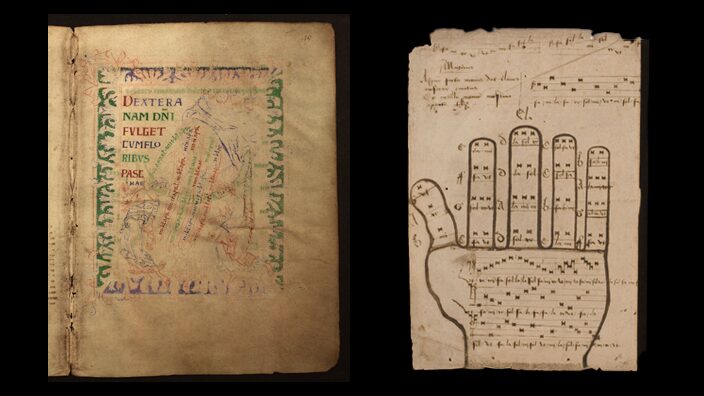
Left: the ‘Hand of God’ inscribed with the dates of Easter from the tenth-century Leofric Missal, held at the Bodleian Library in Oxford. Bodl. 579, folio 49r. Right: Guidonian hand for learning and memorising the scale (16th century), Utrecht, Museum Catharijneconvent, BMH h fragm 29.
The project also examines which gestures were depicted by hands and their role in clarifying, communicating independently, or supplementing the written text.
The supervisors are Prof. Irene van Renswoude and Dr Esther Mulders (both from the University of Amsterdam’s Department of Art History and Book Studies), and Prof. Kathryn Rudy (University of St Andrews, Fellow of the British Academy and the Royal Society of Edinburgh).
The research combines image analysis, textual research, and codicology (the study of the physical characteristics of books). Medieval Latin texts in which hands are explicitly described as teaching aids or communication tools will also be consulted.
Expected results
• A taxonomy of hand images
• A structured inventory of manuscripts containing hand images
• Clear terminology for researchers
• Relevance for medieval knowledge practices
Role of the Huygens Institute
The Knowledge and Art Practices research group at the Huygens Institute studies knowledge and art in European history. We specialise in unlocking and analysing sources that were previously only partially accessible, for example because texts had not yet been digitised. New data provides new insights and thus offers fresh perspectives on the past.
By focusing on hand images, the A Show of Hands project brings together visual culture, material book history, and knowledge transfer. This interdisciplinary approach provides creative insight into how people in the Middle Ages read, learnt and shared knowledge. 👍
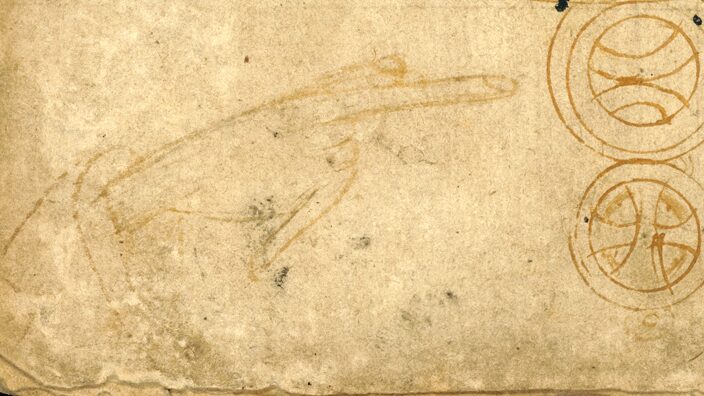
Pointing hand in a manuscript collection (c. 1400), Arnhem, Rozet Heritage Centre, ms 6, fol. 145v (detail).