
Limburg Charters
| Duration: | 2018-2027 |
Legal documents provide a compelling picture of medieval Limburg and its written culture
In collaboration with the Limburg Charter Foundation, the Huygens Institute, led by researcher Geertrui van Synghel, is researching and making available 410 original Limburg charters (deeds) from before 1301. The project combines digitisation, online accessibility and scientific research into Limburg’s medieval history and written culture.
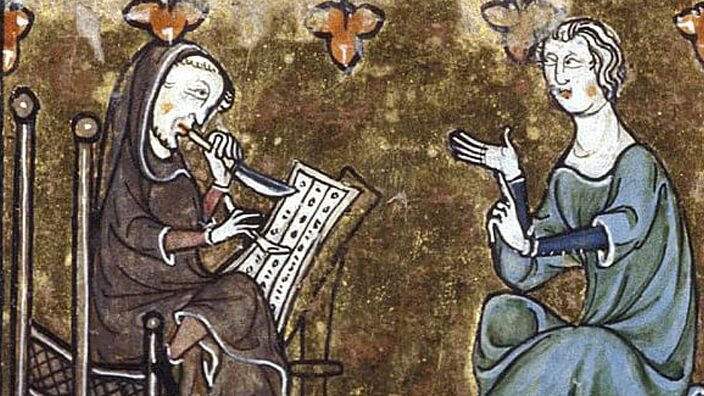
Image from f. 137 of L’estoire del Saint Graal (ff. 1-76); L’estoire de Merlin (ff. 76-216). 1200-1400. British Library.
The charters are often the only surviving sources from this period and offer crucial insights into political, ecclesiastical and economic processes.
Collaborative partners are Stichting Limburgse Oorkonden (Limburg Charters Foundation) and Historisch Centrum Limburg, Maastricht (HCL) (Limburg Historical Centre).
The scans of the original charters are hosted by Historisch Centrum Limburg (HCL) in Maastricht and, upon publication of the printed scholarly edition, will be posted on the Waarvan Akte website. Metadata such as transcription, headnotes, date, archive repository and a short summary of the content make the documents directly usable for historical research, education and the general public. The translations from Latin are unique. This has never been done before in contemporary critically edited scholarly charter books.
Important archives
The project unlocks and transcribes the charters from various Limburg monasteries and churches in their entirety, including:
- Norbertine monastery of Saint Gerlach, Houthem
- Provostship of Meerssen
- Highly revered abbey of Thorn
- Premonstratensian convent of Keizersbos, Neer
- Monastery of Saint Elisabeth, Nunhem
- Various Maastricht monasteries
- Chapters of Our Lady and Saint Servatius
The rich collection provides an overview of administrative, religious and social processes in medieval Limburg.
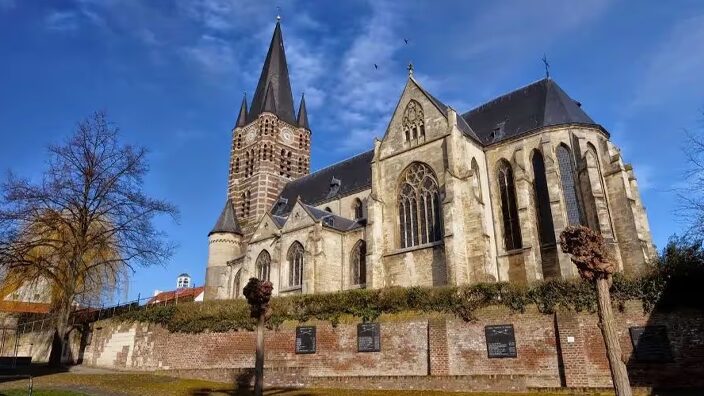
The Thorn collection contains 73 charters from the former High Abbey of Thorn. They date from the period between 950 and 1300. Image: Waarvan Akte website.
Backbone sources and written culture
The Limburg charters are also referred to as ‘backbone sources’ because they are often the only direct witnesses to medieval events. However, studying charters presents challenges:
- Medieval writing and the Latin language
- Different chronological customs and dating
- Identification of persons and places
- The question of whether a charter is genuine or forged (discrimen veri ac falsi)
Diplomatic research can distinguish false charters from genuine ones.
The project is a critical scientific edition of the Limburg charters, both in print and online. The first edition project, started in 2018, concerns 29 charters from the monastery of Saint Gerlach in Houthem.
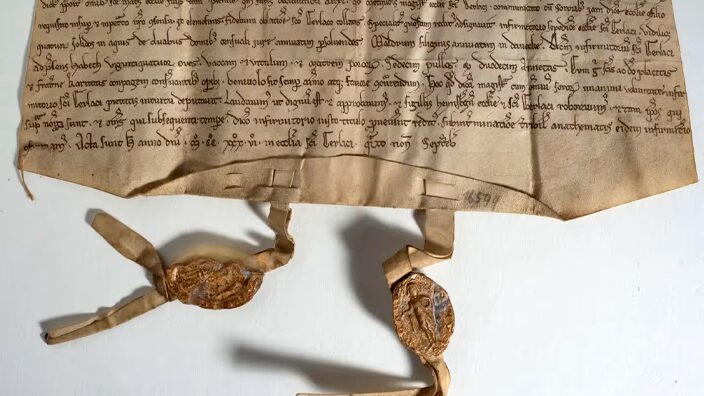
Deed number 5 from Saint Gerlach, 2 September 1236. Hendrik, administrator of the monasteries of Saint Marie (Heinsberg) and Saint Gerlach (Houthem), declares that Mathilde, magistra of Saint Gerlach, allocates an annual rent of four schelling and a malder of rye to the infirmary of Saint Gerlach and confirms the donation of the livestock mentioned in the charter. Image: Waarvan Akte website.
Medieval writing culture in Maastricht
Research into the thirteenth-century alderman’s charters of Maastricht shows that, as early as 1253, the city had scribes who drew up official documents for the city council. Sometimes several writers were active at the same time.
Analysis of language, formulations and typical clauses such as the indemnity clause shows a clear system and continuity in the charters, with a significant change around 1276 to a more compact and stricter form.
The typical Maastricht formulations distinguish the city from other cities. These findings indicate that Maastricht developed an urban secretariat from the mid-thirteenth century onwards, an organised administrative centre for the drafting of official documents.
Importance of the project
The charters are often the only direct sources of medieval processes in Limburg. Digital access and scholarly editions increase accessibility for researchers and the general public. Research into written culture shows how administrative processes and power were organised from the 11th to the 13th century. Critical research into the authenticity of charters ensures reliable historical interpretations.
Find out for yourself!
Take a look at the charters and read the stories on the Waarvan Akte website.
Report in 2025.