
Enduring Empire
| Duration: | 2025-2029 |
| Subsidy provider: | NWO Open Competition Social Sciences and Humanities |
| Subsidy size: | € 399.545 |
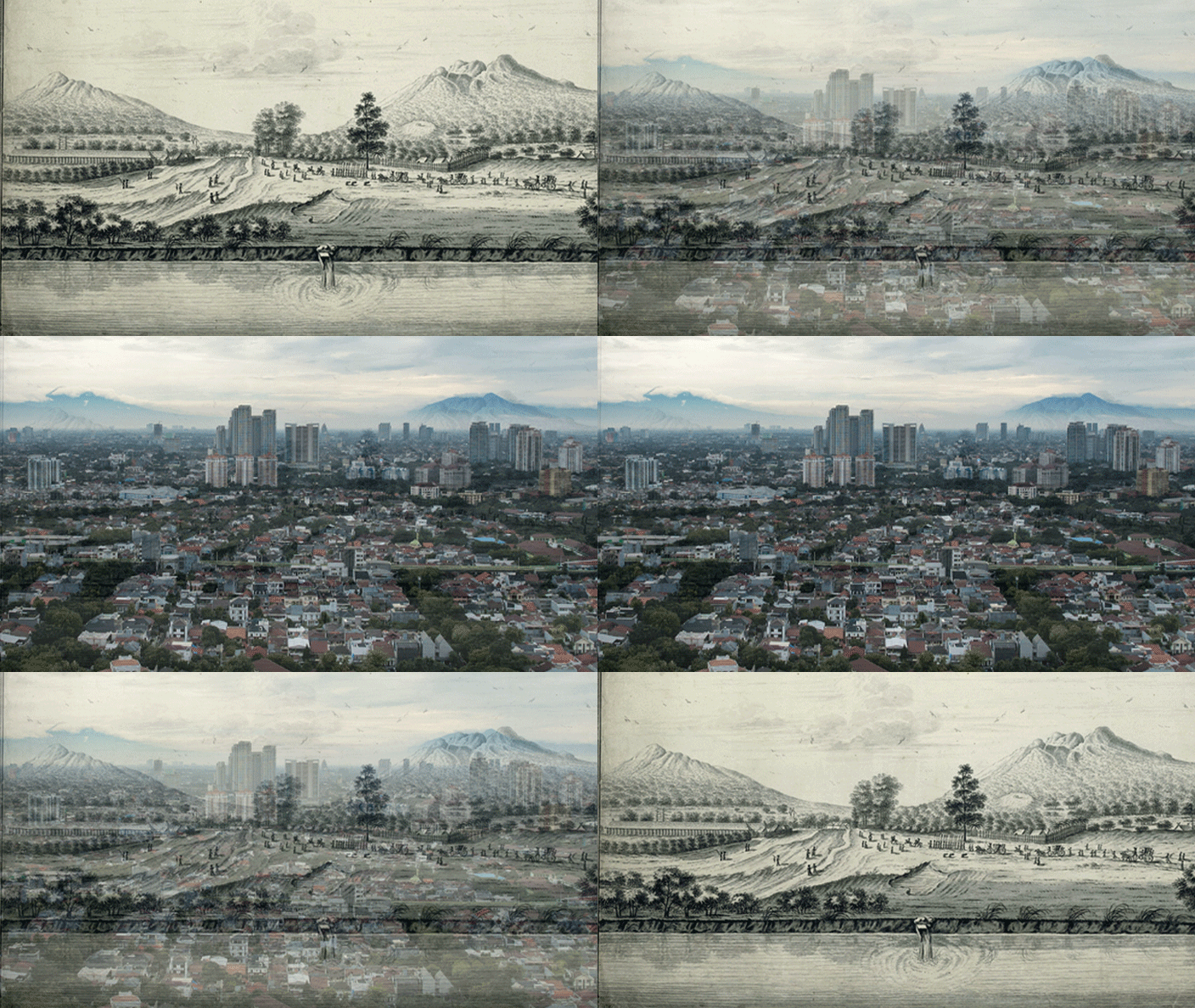
The impact of early Dutch colonialism on contemporary Indonesia
The Enduring Empire project explores how the Dutch East India Company (VOC) in the 17th and 18th centuries continues to shape socio-economic life on Java today. Using newly digitised VOC sources, AI techniques and modern statistical data, the research team will, for the first time, trace large-scale connections between early colonial activities and their contemporary legacy.
The project builds on GLOBALISE, a collaboration between the Huygens Institute, the IISG and other partners. GLOBALISE has made large parts of the VOC archive digitally accessible. Enduring Empire uses transcripts of around five million scans of VOC documents to gather data on infrastructure, population composition and land use. Further information is drawn from historical maps with the help of AI models. The results are then compared with modern socio-economic statistics from the Indonesian Bureau of Statistics (BPS).
Looking at the lasting traces of colonisation
The central question is whether, and in what ways, the presence and activities of the VOC have left enduring marks on Java’s economic and social fabric. The project connects with globally influential studies on the long-term effects of colonialism, such as the work of Nobel Prize winners Acemoglu, Johnson and Robinson. While much of that research has focused on the 19th and 20th centuries, the availability of newly digitised resources and data extraction techniques now makes it possible to look further back in time.
Both quantitative and qualitative research
Enduring Empire combines quantitative and qualitative approaches. The quantitative core of the project consists of econometric analyses exploring causal links between VOC records and present-day socio-economic indicators. For example, researchers will test whether early VOC-built infrastructure has had a lasting impact on the economic development of certain regions.
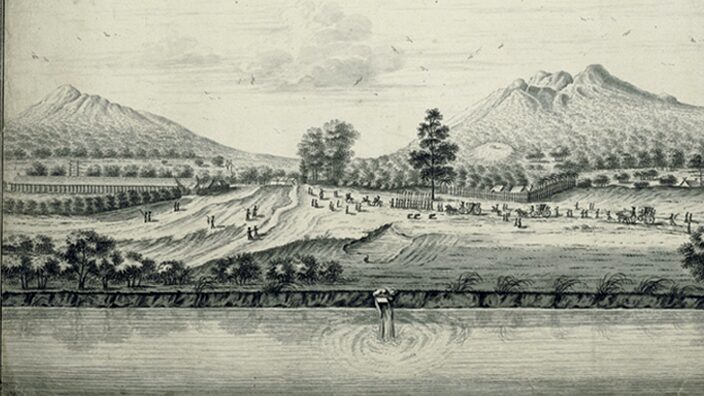
View of the Salaka and Pangrango mountains on Java, from Buitenzorg (now Bogor), 1769. A low building on the left flies the Dutch flag. Rijksmuseum collection.
The qualitative research draws on historical accounts and secondary literature. This step is essential for interpreting statistical patterns in their historical context: what do they mean, and how do they relate to existing knowledge of Java’s history?
All datasets and annotations produced by Enduring Empire will be published open access, allowing other researchers to reuse them freely.
Partnerships
The project is a collaboration between the Huygens Institute and the Erasmus School of Economics. The Huygens Institute contributes expertise in VOC sources and digital methods, while the Erasmus School provides knowledge in causal analysis and development economics. The project also seeks collaboration with Indonesian partners, such as BRIN and the Indonesian Bureau of Statistics (BPS), both to exchange methodological expertise and to connect with the country’s academic community.
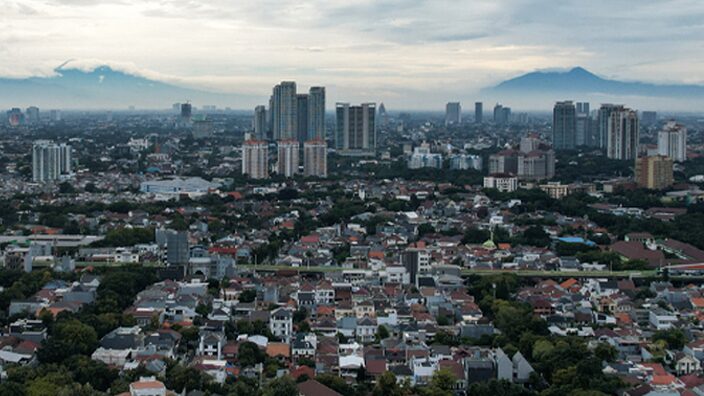
Skyline of Jakarta with the Salak and Pangrango mountains in the background, 2022. Image: Vecteezy.com.